
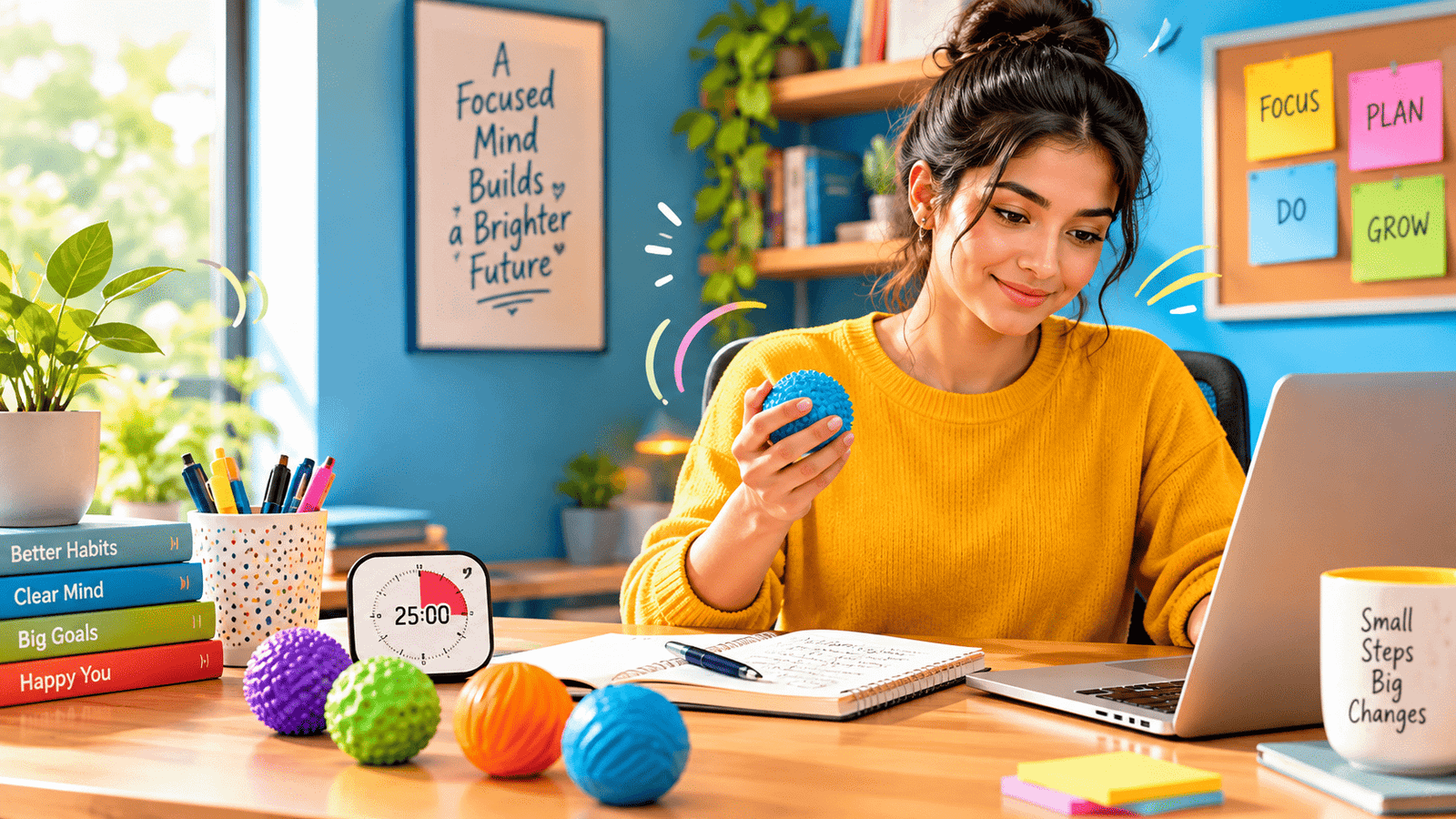
Focus balls can help some people stay on task by giving restless hands something quiet to do. They work best for simple, repeated tasks and for people who already fidget. They are not a guaranteed fix, and the research is mixed. Pair them with short breaks and a clear task list.
How to try focus balls in five steps:
- Pick one small task, like reading or answering emails.
- Keep the ball in your non-writing hand, out of your line of sight.
- Squeeze or roll it slowly while you work, not fast.
- Put it down if you catch yourself watching it instead of the task.
- After 25 minutes, take a short break and check if it helped.
What Are Focus Balls and Why Are People Talking About Them?
Focus balls are small, hand-sized balls you squeeze, roll, or press while you work or study. Some are soft. Some have bumps, ridges, or different textures. The idea is simple. If your hands are busy with something calm, your mind may find it easier to stay put.
You may have seen them called stress balls, grip balls, or sensory balls. The names change, but the goal is the same: give the body a small job so the brain can do the big one.
Focus Balls vs. Stress Balls vs. Fidget Toys
A stress ball is made for squeezing when you feel tense. A fidget toy, like a spinner, often asks for your eyes as well as your hands. A focus ball sits in between. Good ones are quiet and simple, and you can use them without looking. That last part matters. A tool that pulls your eyes away from your screen or book is a distraction, not a focus tool.
Why Your Mind Wanders in the First Place
Before we talk about tools, it helps to know what you are up against. Most of us do not lose focus because we are lazy. We lose it because our days are full of small breaks in attention.
The Real Cost of Every Interruption
Gloria Mark, a researcher at the University of California, Irvine, has studied office workers for many years. Her work found that after an interruption, people often need more than 20 minutes to get fully back to what they were doing. That means a few pings from your phone can eat a big part of your afternoon.
Attention Residue: Why Your Brain Stays Stuck on the Last Task
Sophie Leroy, a business school professor, wrote about something she called attention residue. When you switch from one task to another, part of your mind stays behind on the first one. So you are sitting at task two, but you are still half-thinking about task one. This is why jumping between tabs, chats, and files leaves you tired and scattered.
A focus ball cannot fix any of this by itself. But it can be one small piece of a better setup, and that is where it earns its place.
What Research Says About Focus Balls and Fidgeting
Here is the honest part. There is not a lot of research on focus balls in particular. There is more on fidgeting and movement in general, and the results are not all in one direction. Here is what we can say fairly.
Movement Can Help Some Brains Think
A 2015 study led by Dustin Sarver and colleagues looked at children with ADHD. It found that more body movement was linked to better working memory on hard tasks. In plain words, for some kids, moving seemed to help the brain hold on to information. That study was about children with ADHD, so we should not stretch it to everyone.
Fidget Toys Can Also Backfire
In 2018, Alyson Graziano and her team tested fidget spinners with children who had ADHD. The spinners did not help. Attention and performance got worse for many of them. The likely reason is that a spinner is fun to watch, so it steals attention. This is a big reason we lean toward quiet, low-interest tools for focus work.
Short Breaks Have Strong Support
Research by Alejandro Lleras and Naoyuki Ariga, published in 2011, found that brief mental breaks helped people keep their attention steady during a long task. The lesson is that a good focus routine is not only about a tool. It is also about rest built into your work time.
Taken together, the science says this: movement may help some people, the wrong toy can hurt, and breaks matter a lot. Focus balls sit somewhere in the middle. They can be useful, but they are not magic.
Is Any Focus Tool Truly Fail-Proof?
We will be straight with you. The word “fail-proof” is a big claim, and no ball, app, or planner deserves it. People are different. A tool that helps one person concentrate may do nothing for the next.
That said, you can make a routine that is very hard to fail. It has three parts. First, a small tool that keeps your hands calm. Second, a short work block with a clear end. Third, a real break afterward. If you want to see how one writer thinks about a fail-proof mindset, our guide on mental armor is a good next read. The main idea is that you build habits so strong that one bad day does not break them, rather than relying on one tool to do everything.
A helpful way to think about it: the ball is not the plan. The ball supports the plan.
How to Choose the Right Focus Ball
Not all focus balls are the same. When you shop, look at a few simple things.
Texture and Feel
Some people like a smooth, soft ball. Others need bumps or ridges to feel something under their fingers. Multi-textured options give you more choice, which can help if you get bored of one feel. For example, the ZenSphere multi-textured stress and focus grip ball in our shop is made for people who like changing textures while they work. It sells for ₹399 at the time of writing, down from ₹1,000.
Size and Grip
A good focus ball fits in one hand without effort. If it is too big, your hand gets tired. If it is too small, it is easy to drop. Try to pick something you can hold for a while without thinking about it.
Noise and Looks
If you work in an office or class, silence matters. Pick a ball that does not click, squeak, or bounce. Simple colors are better than bright, busy ones, because you want the ball to fade into the background. If you like a smooth, calm object, The Orb of Clarity is a plain, palm-sized option at ₹559.20. If you want something with more parts to press and stretch, the ZenSphere and ChromaStretch kit is priced at ₹799.20. Prices can change, so check the product pages before you buy.
How a Knowledge Person Can Use Focus Balls at Work and Study
A knowledge person is anyone whose main job is thinking: writers, students, coders, analysts, teachers, and marketers. If that sounds like you, your biggest enemy is not a lack of skill. It is the constant pull of tabs, chats, and ideas. Here is a simple way to build a routine around a knowledge person mindset.
Match the Ball to the Type of Work
Focus balls tend to work best during tasks that are steady and a bit dull, like reading, listening in a meeting, editing, or going through email. They may work less well during tasks that need your hands, like typing or drawing. If you notice your typing gets messy when you hold the ball, switch hands or put it down.
Use a Timer
Set a timer for 25 to 30 minutes. Work with the ball in your hand. When the timer ends, put the ball down, stand up, and move for five minutes. This pairs the calm hands with a proper break, which the research above says is the part that really counts.
Clean Up Your Space First
A ball will not help if your desk is a mess and your phone is buzzing. Clear the desk, silence your phone, and close extra tabs. Then bring in the ball. A useful desk setup can be as simple as a clean surface, a notebook, and one focus item. Some people also like a mouse pad with a single word on it, such as “Focus,” as a small visual reminder.
Write Down One Goal
Before you start, write one sentence about what you want to finish. Prompts can help here. Our Deep Focus and Flow State prompt pack has 100 prompts for setting up a distraction-free work session, and it is priced at ₹99.
Common Mistakes People Make With Focus Balls
Most problems come from using the ball the wrong way. The first mistake is playing with it too much. If you are watching it, tossing it, or showing it to a coworker, it has become a toy. The second mistake is using it for every task. Some work needs both hands and full attention. The third mistake is expecting it to fix a bigger problem. If you are tired, stressed, or short on sleep, no ball will save your afternoon.
One more thing worth saying. If you often struggle to focus, or if it is getting in the way of school or work, talk to a doctor or a mental health professional. A focus ball is a small helper, not a treatment. This article is for general information and is not medical advice.
Small Habits and Inspirational Blogs That Keep Your Focus Strong
Good focus is built in small pieces. A ball might be one of them. Others include sleeping enough, drinking water, taking walks, and reading things that keep you steady. Many people find that a short daily read from inspirational blogs helps them start the day in a calmer mood. What matters is that it is short, honest, and something you will actually do.
If you want a simple starting point, pick one habit and keep it for two weeks. Maybe it is the 25-minute work block. Maybe it is putting your phone in another room. When that feels normal, add the next one. This slow way of building is far more likely to stick than a big, dramatic reset.
Final Thoughts: Simple Tools, Honest Expectations
So, are focus balls a fail-proof way to improve focus? Not quite. They are a small, low-cost tool that can help some people keep their hands calm while their mind does the work. The research on fidgeting is mixed, the wrong toy can hurt, and short breaks and a clean workspace often matter more than any object.
Still, if you are someone who fidgets, taps, or picks at things while you think, a quiet focus ball is worth a try. Start small, pick one task, use a timer, and see how you feel. If it helps, keep it. If it does not, you have lost very little and learned something about how you work.
Motivation N You is a team of writers and creators who share simple, practical ideas for building better habits, a calmer mind, and steadier focus. We publish guides, prompt packs, journals, and desk-friendly tools so you can turn small daily choices into lasting progress.
Frequently Asked Questions
Do focus balls help with ADHD?
Some people with ADHD say that quiet hand movement helps them concentrate, and a 2015 study linked more movement to better working memory in children with ADHD. Other research on fidget toys has shown mixed or negative results. If you or your child has ADHD, ask a doctor or specialist what fits best.
Are focus balls the same as stress balls?
They are close, but not identical. Stress balls are mainly for releasing tension. Focus balls are chosen to be quiet, comfortable, and easy to use without looking, so they stay in the background while you work.
How long should I use a focus ball each day?
There is no set rule. Many people use one in work blocks of 25 to 30 minutes, then rest. If you feel it is helping, keep going. If you notice you are watching it more than your work, put it away.
Can focus balls work for kids?
They can, but the quiet, low-interest kind is better than flashy toys. Children should use them with guidance from a parent or teacher, and the ball should never replace help from a professional if a child has trouble focusing.
What is the best way to make focus balls part of a daily routine?
Tie it to something you already do. Use it during your first reading block of the day, or during your daily meeting. Habits stick better when they are attached to something that already happens.