Every year, millions of people download motivational ebooks hoping for that one spark that changes everything. They finish the book feeling inspired, energized, ready to conquer the world. Then life happens. By Tuesday, the motivation fades. The new habits collapse. The ebook sits unread on your phone, gathering digital dust alongside three other self-improvement books you never finished.
The real question isn't whether motivational ebooks work. It's this: what separates the people whose lives genuinely transform through reading from those who feel temporarily inspired and nothing else?
The answer lies not in the book itself it lies in what you do after you finish reading.
This article looks at real stories of people whose lives changed through motivational ebooks, the specific tools they used to lock in those changes, and a proven framework you can use to make sure your next ebook investment actually sticks. We'll also explore how combining reading with physical reminders like a white coffee mug with motivational quotes or home office wall decor India can reinforce what you're learning and keep you accountable long after you close the final page.
Before we talk about Rajesh's story, let's understand the honest data about how motivational ebooks influence behavior change. Research from James Clear's Atomic Habits (which itself became a global phenomenon as both print and ebook) shows that reading about habits changes roughly 15% of your thinking. The other 85% of change comes from the environment, systems, and repeated small actions.
This explains why someone can read a life-changing ebook on Monday and feel completely unmotivated by Friday. The book gave you knowledge. Knowledge alone doesn't stick without systems around it.
The most successful people who use motivational ebooks don't just read them passively. They actively integrate what they learn into their daily environment and routine. They use AI Prompts for Self Improvement to reinforce key ideas. They place reminders around their workspace. They talk about what they learned. They turn insights into visible systems.
This active integration is what we'll explore through Rajesh's real story.
Rajesh was a 38-year-old marketing director at a multinational tech company in Bangalore. By the surface measures of success, he had everything. A 15-year career trajectory, a solid salary, a well-maintained apartment, and the respect of his team. Internally, he was falling apart.
He was working 60-hour weeks. His sleep was inconsistent usually 5-6 hours, sometimes broken across the night by work anxiety. His health had declined. He hadn't exercised in three years. His marriage was strained because he was emotionally unavailable even when physically present. Most painfully, he felt like he was living someone else's life, following a script he'd never actually agreed to.
The turning point came at 11 PM on a Tuesday when Rajesh realized he was sitting in his home office doing work email instead of sleeping, and he had zero idea why this was his reality. He felt trapped by the very success he'd worked so hard to build.
The next morning, Rajesh did what many people do: he downloaded three books onto his phone. One was Atomic Habits. Another was a smaller ebook on intentional living. A third was about corporate burnout recovery. He hoped that just by reading about change, something would shift.

For the first few weeks, nothing did. He'd read for 15 minutes before bed, feel inspired, then slip back into the same patterns the moment work pressure returned.
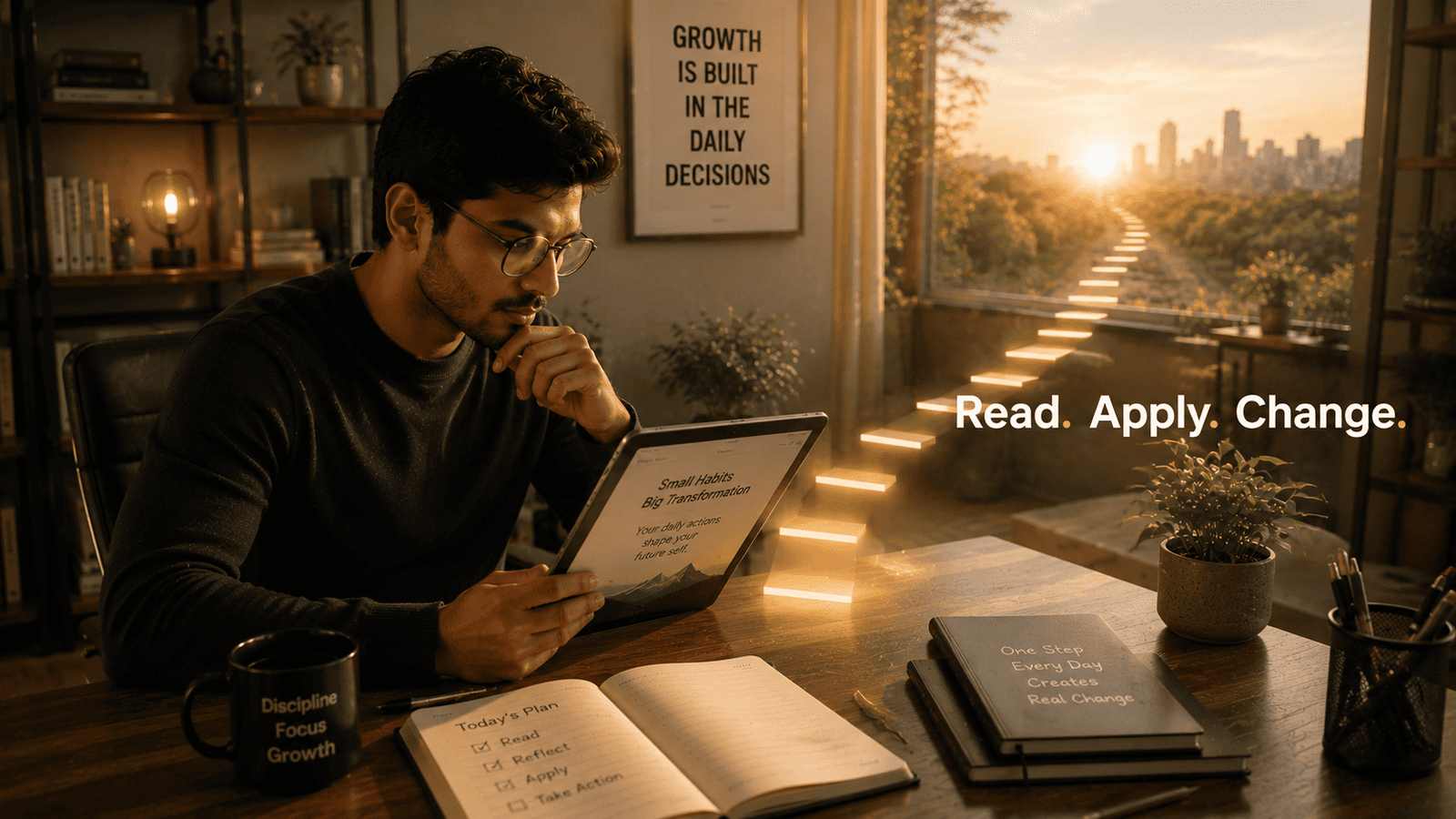
The breakthrough came when Rajesh realized that reading alone wasn't enough. His environment was working against him. His home office was decorated with corporate awards and performance metrics, a physical reminder of the achievement-focused life he was trying to step back from. His coffee mug said nothing. His workspace offered no friction against overwork.
So Rajesh did something different. He bought a white coffee mug with motivational quotes that said "Slow down to speed up." Every morning, making his first cup, he saw those words. Not as inspiration, but as a system, a tiny environmental cue that reminded him why he was reading Atomic Habits in the first place. He added home office wall decor India with a simple mantra about balance, not performance. He placed a small kids educational wooden puzzle India on his desk a reminder that not everything had to be about productivity, that play and unstructured thinking mattered.
Most importantly, he moved beyond just reading. He used the habit framework from Atomic Habits to build a specific system:
Morning: Meditate for 5 minutes (cue: the mug). Read one page of motivational ebook content (cue: sitting with coffee). Journal one insight (reward: clarity).
Afternoon: Walk for 20 minutes during lunch (cue: leaving desk at noon, a hard work motivational mug on desk). No work email during walk (rule: phone off).
Evening: Mark 6 PM as "work stops here" with a ritual changing clothes, telling his wife, stepping away from home office.
These weren't big, dramatic changes. They were small, daily systems that made the ideas in the ebook stick through environmental design. The mug wasn't just a mug it was a decision point. The wall art wasn't decoration it was a norm reminder. The puzzle on his desk wasn't a toy it was permission to think differently.
Over three months, Rajesh's sleep improved to 7-8 hours. He started exercising 4 times a week. His marriage recovered. His work anxiety decreased not because the work changed, but because his relationship with it changed. He actually implemented the habit loops described in Atomic Habits, not just read them.
Within six months, Rajesh had reshaped his entire relationship with work and ambition. He didn't quit his job. He didn't reject success. He simply redefined what success meant to him. And it started with a book but it only stuck because of the systems he built around it.
Rajesh's story illustrates a repeatable pattern. We call it the C.O.R.E Framework—a method to move from passive reading to active life change.
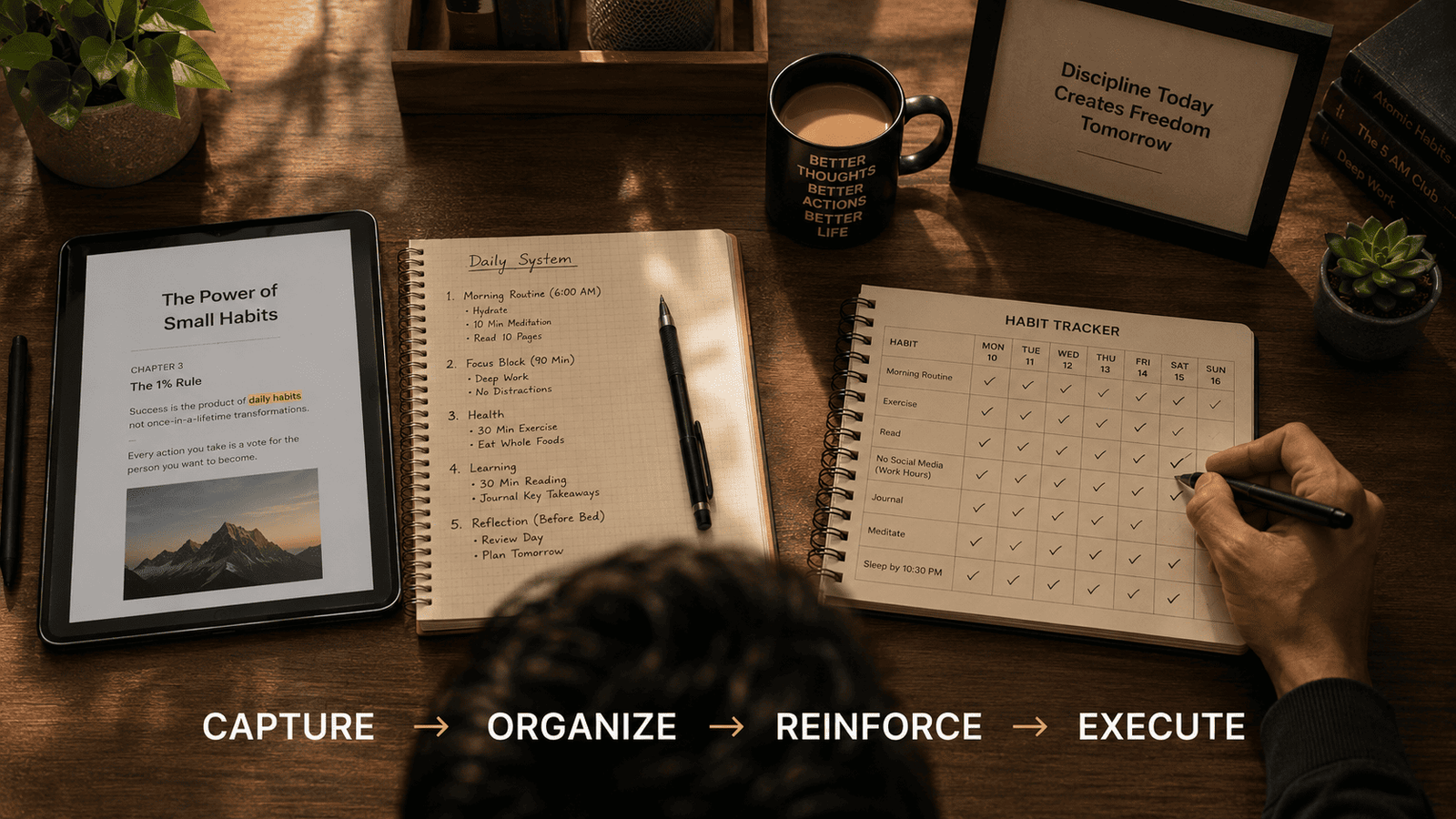
Don't just read the whole ebook passively. Identify the 3-5 core ideas that actually resonate with your current situation. For Rajesh, it was: (1) small habits compound, (2) environment shapes behavior, (3) systems beat motivation.
Write these down. Don't try to implement everything. Just identify what's relevant to where you are right now.
Take your core ideas and design one small system around them. Rajesh didn't overhaul his entire life. He created three specific rituals: morning meditation and reading, midday walk, and evening "work stop" time.
The system doesn't need to be complex. It needs to be small enough that you can sustain it for 66 days (the research average for habit formation). One cup of coffee. One ritual. One motivational mug as a cue.
This is where most people fail. They read the book, understand the idea, even start the habit—then their environment works against them. A blank wall. A generic mug. No visual reminder of why they're doing this.
Rajesh used home office wall decor India, a motivational mug, and physical objects to make his environment reinforce the ebook's message. Every time he saw the mug, he remembered "slow down to speed up." Every time he passed the wall art, he recalled the importance of balance.
For the first 8-12 weeks, consistency matters more than perfection. Rajesh didn't need to meditate perfectly. He needed to do it every single day. The habit was more important than the quality of execution.
After the first habit solidified, he evolved. He added different systems. He read more ebooks. He started using AI Prompts for Self Improvement to reflect deeper on concepts. But this only happened after he'd proven the first system could stick.
Beyond the C.O.R.E framework, three categories of tools have proven most effective for locking in ebook-driven change:
A white coffee mug with motivational quotes isn't just merchandise. It's a cue object. Your brain notices it 50+ times per day if it's in your workspace. Each time you see it, you're reminded of the ebook's core idea without having to consciously remember. This is called "environmental design" making the right choice the easy choice.
Similarly, home office wall decor India transforms your space from a generic office into a values-aligned environment. When you work surrounded by affirmations that reflect what you're trying to become, you're competing against your own environment less.

Reading the ebook once isn't enough. Your brain needs spaced repetition. AI Prompts for Self Improvement allow you to revisit core concepts through specific, structured questions. Instead of rereading the entire ebook, you can use a daily prompt that forces you to think deeply about one concept for 5 minutes.
This bridges the gap between knowledge and action. Knowledge tells you what works. Daily prompts force you to apply it.
The third tool is external. Journal about what you learned. Tell someone else about the ebook. Join a community of people reading the same book. Use kids educational wooden puzzle India as a metaphor for life systems small pieces that fit together to create the bigger picture.
Rajesh's evening ritual of telling his wife he was done with work wasn't just about personal discipline. It created accountability. His wife could now see when he broke the rule, and he couldn't hide from it.
A 2024 study on self-improvement literature found that 87% of people who read motivational ebooks experience temporary motivation but zero lasting behavior change.
The gap isn't in the books—many are genuinely well-written and evidence-based.The gap is in implementation. Reading a book on habits doesn't build habits. Reading a book on discipline doesn't create discipline. It creates awareness. Discipline comes from daily systems that reinforce the book's ideas until they become automatic.
This is why combining motivational ebooks with physical tools and environmental design works so much better than reading alone. The ebook gives you the framework. The mug gives you the daily reminder. The ritual gives you the accountability. Together, they work.
According to habit researcher James Clear, motivation typically lasts 2-3 weeks. Systems last forever. An ebook can inspire you for 2-3 weeks. A system built around the ebook's core concepts can change your life for 2-3 years and beyond. This is why Rajesh's morning ritual with his motivational mug mattered more than the ebook itself. The ritual was the bridge between knowledge and behavior.
The most underrated tool for ebook-driven change is environmental design. Your brain is lazy it follows the path of least resistance. If your home office wall decor India contradicts the ebook's message, your environment wins. If your physical space reinforces what you're trying to become, behavior change becomes effortless.

At Motivation N You, we've learned from thousands of customers that people don't fail because books are bad. They fail because they treat ebooks as standalone tools instead of as one piece of a system.
That's why we created the Complete Change Bundle: Motivational ebooks paired with a white coffee mug with motivational quotes, AI Prompts for Self Improvement for daily reinforcement, and home office wall decor India to anchor your new identity.
Because we know that real change happens in the gap between reading and living. And that gap closes fastest when every part of your environment is working toward the same goal.
Motivation N You is an India-based e-commerce brand committed to creating products that bridge the gap between inspiration and implementation. We design and sell motivational ebooks, ceramic and enamel mugs with powerful affirmations, AI Prompts for Self Improvement, home office wall decor India, daily planners, and kids educational wooden puzzle India designed to make learning fun and sticky.
Our belief is simple: real change doesn't come from motivation alone. It comes from systems, environment, and daily reinforcement. Every product we create is designed to be part of a system. Whether you're using a hard work motivational mug as a daily reminder or working through motivational ebooks with intentional systems around them, our products exist to help you close the gap between who you are and who you're becoming.
We serve young professionals, entrepreneurs, students, and families across India who are serious about growth not just inspired by it.